

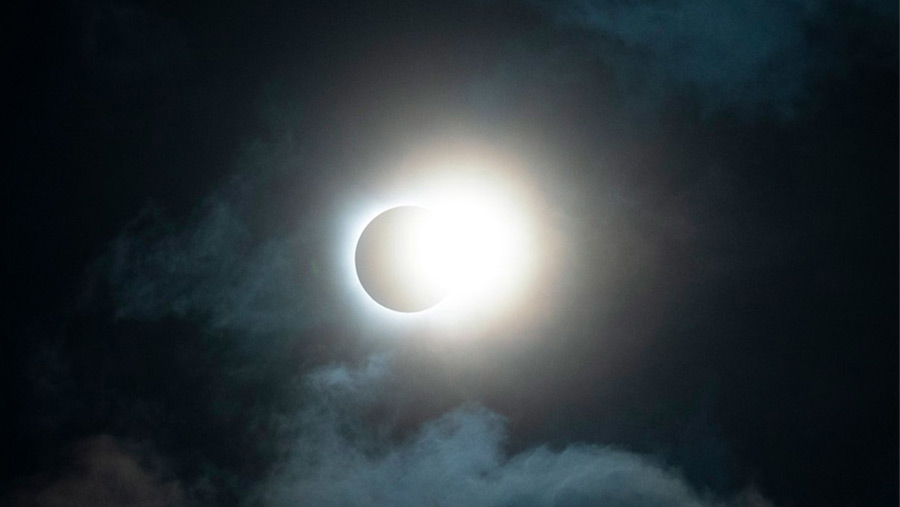
A total solar eclipse passed over North America on Monday (Apr 8), putting on a dramatic show that was visible to millions of people.
A total solar eclipse occurs when the moon passes between Earth and the sun, completely blocking the sun's face. Those within the path of totality, including 32 million people in the United States, saw the eclipse in its full splendor. People outside the path were still able to see a partial solar eclipse, where the moon blocks only part of the sun's face.
Many people traveled to the path of totality to attend special viewing parties. Those along the very center line of the path saw an eclipse that lasted between 3½ and 4 minutes, according to NASA.
For many Americans, this was the last chance to see a total solar eclipse for 20 years. The next one won't be visible across the contiguous United States until August 2044.
Across Mexico, the U.S. and Canada, inside a ribbon of land stretching 155 miles wide but more than 4,000 miles long, tens of millions of people craned their necks, tilted their heads to the sky and watched in wonder as the day turned to night.
What many saw on Monday was a phenomenon like no other: the Moon moving between the Earth and the Sun, extinguishing its light in a total solar eclipse.
The path of totality spanned the continent, beginning over the warm sands of a Mexican beach town and darkening the skies above the crashing waters of Niagara Falls before ending its journey on the shores of Canada's Newfoundland.
It left a sense of awe in its wake, a reminder of our planet's place in the universe.
The eclipse was first seen around Mazatlán, Mexico, on the country's western shores at 11:07 local time (18:07 GMT).
At first, the Moon's outer edge seemed to just be touching the Sun. Then it devoured more and more until cheers erupted as all finally went dark – save for the silvery glow of the "corona" effect of the Sun around the Moon's outline.
(Compiled)